

While playing the second or third game, it dawned on me that there is no better definition of the phrase "for the greater good" than most of the strategies used in this game. This thought occurred to me when I had to kill a couple of my own pieces in order to be able to kill the opponent's pieces and eventually win the game. But the need for strategic decisions such as this one do not only occur in a simple board game, whether its just a business decision, a personal decision such as abortion or divorce, or a strategic decision to be taken by a general during a war. But is it justifiable to sacrifice a little for the greater good?
 In ethics, this approach is called Utilitarianism, and it theorizes the fact that the course of action that maximizes happiness and reduces suffering the most should always be chosen when faced with an important decision. This idea has always been in the heads of basically everyone and always seemed to be the most logical path to follow while trying to make a sound decision, rather than acting rashly in the spur of the moment. But it was Jeremy Bentham ,with his long silvery hair as seen in his portrait on the right, and his book titled "An Introduction to the Principles of Morals and Legislation" in the late eighteenth century, and then followed by John Stuart Mill and his articles in Fraser's Magazine in 1861 that actually started exploring these theories and the philosophy behind them.
 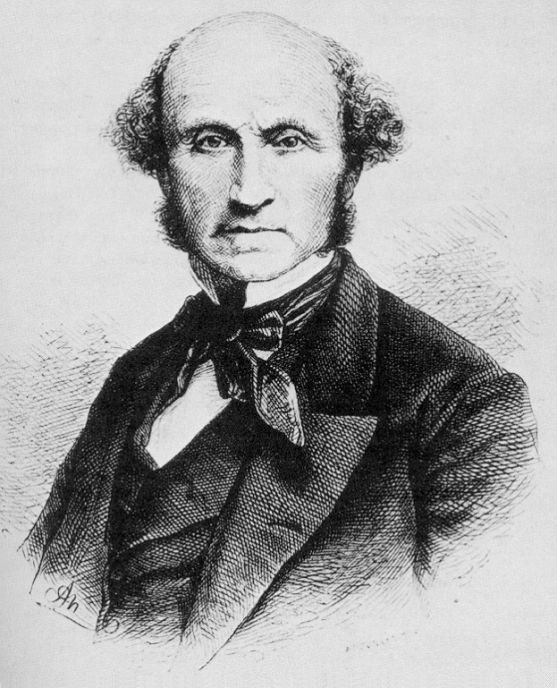 But is utilitarianism in itself acceptable as a modern way of thinking and making decisions? Along the years, several arguments have been made that it depends on the sacrifice in the particular situation that determines whether its morally acceptable to sacrifice and what for the greater good. Of course, the thought in itself, the sacrifice of something (or someone) for the greater good is remarkably noble. But should there be a limit for what one should be ready to sacrifice in order to obtain this greater good? Of course there should be! It was John Stuart Mill himself who, even though he had an extremely ridiculous hairstyle, said that "If all mankind minus one, were of one opinion, and only one person were of the contrary opinion, mankind would be no more justified in silencing that one person, than he... would be justified in silencing mankind." And in my opinion, that summarizes all of the ethical implications of the argument, that even though it is for the greater good, even if it is one man against the rest of mankind, his opinion is still valid and not even one human being should be sacrificed, for that human being has the same fundamental rights as all of the others.
And that is the limit, or boundary, that we were looking for, regarding that to sacrifice or not for the greater good. It is the involvement of another human being, especially when his or her life itself is at stake, that even though for the greater good, we are still exactly the same kind of human beings like the one in question, and if we do not want anyone or anything to judge us and have control over us, then we should not judge, or have control over the actions, or life, of someone else.


